Treat-Dispensing Tumbler Toy | Slow-Feed Puzzle, Elliptical Rolling Track, Durable Build
Couldn't load pickup availability
check_circle Free Shipping
check_circle 30-Day Guarantee
check_circle Secure Checkout
-
Ordered
- - -
Order Ready
- - -
Delivered
Treat-Dispensing Tumbler Toy | Slow-Feed Puzzle, Elliptical Rolling Track, Durable Build
Your dog eats like they're competing. Bowl goes down. Head goes in. Food vanishes. The whole thing is over in under a minute and your dog is looking at you like you forgot the second course.
They ate so fast they didn't chew half of it. Twenty minutes later they're burping, gassy, or throwing up on the carpet because their stomach didn't have time to register what just happened.
Fast eating isn't greed. It's instinct. Dogs are wired to eat quickly because in the wild, the animal who finishes first doesn't get their food stolen. Your dog doesn't have competition, but their brain hasn't caught up to that reality.
So they vacuum the bowl, their stomach bloats, digestion suffers, and you're left cleaning up the aftermath of a meal that lasted less time than it took you to prepare it.
Slow feeder bowls help with this, but they're a passive solution. The food is still just sitting there. Your dog figures out the pattern of the ridges within two meals and eats almost as fast as before, just with more frustration. There's no engagement. No problem-solving. No reason for your dog's brain to activate. It's a speed bump, not a challenge.
Then there's the other half of the day. After the meal is gone, your dog has nothing to do. You're at work or busy. Their toys are all on the floor, already investigated, already boring.
A dog with a full stomach and an empty schedule is a dog who chews the skirting boards, barks at nothing, digs at the couch cushions, or follows you from room to room because you're the only interesting thing left in the house. The eating problem and the boredom problem are connected. Your dog needs their food to take longer, and they need something to do with their brain. This solves both at the same time.
How It Actually Works
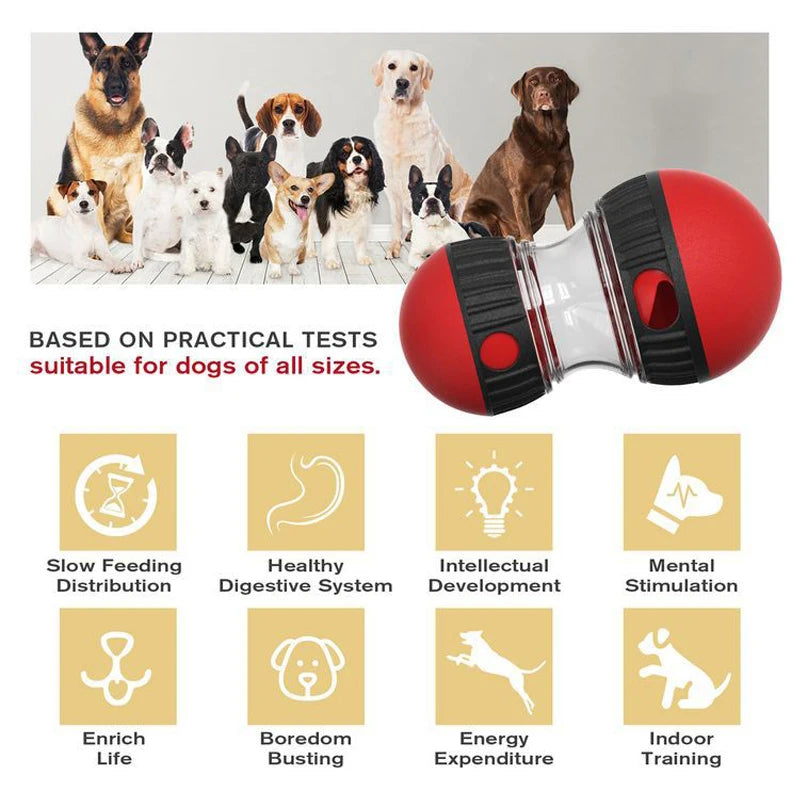
This is a tumbler-shaped toy with a transparent centre chamber that holds kibble or small treats. The shape is elliptical, not round, which means it doesn't roll in a straight line. When your dog pushes it, the toy wobbles, tilts, rolls along a curved path, and changes direction unpredictably. As it moves, treats fall out through small openings one or two at a time.
Your dog has to figure out the relationship between their actions and the reward. Push it this way, a treat falls out. Push it that way, nothing. Nudge it from the side, two come out. Nose it too hard and it rolls away. The elliptical shape makes every interaction slightly different, which means your dog can't learn a single repeatable motion and autopilot through it. They have to keep adjusting, keep experimenting, and keep engaging their brain.
This is what enrichment actually means. Not just a toy. A problem that dispenses food when your dog solves it, and keeps changing the problem slightly every time. The mental effort of working through a puzzle feeder is genuinely tiring.
Fifteen minutes of working this toy burns more mental energy than an hour of lying on the couch. Dogs who use puzzle feeders regularly are measurably calmer, less destructive, and more settled during downtime because their brain got a workout along with their stomach.
The treat chamber is transparent, so your dog can see the food inside. This is deliberate. The visual of food they can see but can't immediately access drives engagement.
They know the reward is there. They just have to figure out how to get it. That's motivation built into the design.
The outer shell is made from durable, sturdy plastic that handles being pushed across hard floors, batted around the kitchen, and nosed into furniture legs without cracking. The toy is weighted at the base, which is why it wobbles and rights itself rather than tipping over and lying flat.
Your dog can't just flip it upside down and shake the food out. The weighted base brings it back upright, which forces them to interact with the rolling mechanism rather than bypassing it.
The treat openings are adjustable or sized to control the difficulty. Larger kibble or treats come out less frequently, which makes the puzzle harder and the feeding session longer. Smaller treats fall out more easily, which is a better starting point for dogs who've never used a puzzle feeder and need early success to stay interested.
Colours
Green (yellow/teal combination) and Red/Grey. Both function identically. Pick whichever you prefer.
What to Fill It With
Dry kibble. Small training treats. Broken-up biscuits. Anything small enough to fit through the dispensing openings and dry enough not to clog them. Don't use wet food, raw food, or anything sticky. The inside needs to stay clean and the food needs to tumble freely.
You can use this as your dog's entire meal delivery system. Instead of putting their breakfast in a bowl, put it in the tumbler. A meal that used to take forty seconds now takes fifteen to twenty minutes. That's fifteen minutes of mental stimulation, slowed digestion, and your dog earning their food the way their brain is designed to.
"My dog has never used a puzzle toy. Will they figure it out?" Most dogs figure it out within the first session. They investigate the toy, smell the food inside, bump it accidentally, a treat falls out, and the connection is made. If your dog seems confused, help them the first time.
Tip the toy gently in front of them so a treat comes out. Once they see the cause and effect, instinct takes over. Start with small, easy-to-dispense treats so the reward comes quickly and often. You can increase difficulty as they improve.
"Will it be too easy for a smart dog?" Smart dogs figure out the basic interaction quickly, but the elliptical shape means the toy never becomes fully predictable. The wobble and curved rolling path change with every push.
You can also increase difficulty by using larger treats that take more rolling to dislodge, or by reducing the amount of food so each reward requires more effort. Dogs who solve standard puzzle toys in minutes tend to stay engaged with tumblers longer because the physics keep shifting.
"Is it loud on hard floors?" It makes some noise. A plastic toy rolling across tile or hardwood produces a rumbling sound. On carpet, it's quieter but also moves less freely. If noise is a concern, use it on a rug or a mat. Most dogs play with it in focused sessions rather than batting it around the house constantly, so the noise is contained to feeding time.
"Can I use this for a cat?" You can. Cats are natural puzzle solvers and respond well to toys that dispense food through interaction. Whether your cat will engage with a tumbler toy depends entirely on your cat's personality. Some cats love it. Some cats stare at it and go back to sleep. Cats who are food-motivated and enjoy batting objects are the best candidates.
"How do I clean it?" The chamber opens for filling and cleaning. Rinse with warm water after each use, especially if the treats left oil or residue inside. A bottle brush helps reach the interior. Air dry completely before refilling. Don't put it in the dishwasher. The plastic and weighted base aren't designed for high-heat washing.
"Will a power chewer destroy it?" The toy is built to handle pushing, rolling, and nosing. It's not built to withstand a dog who picks it up in their mouth and chews through the plastic shell.
If your dog's approach to puzzle toys is to bypass the puzzle by destroying the container, this will have a short life. For dogs who interact with it the way it's intended, pushing with their nose and paws, it holds up well.
Backed by our 30-Day Satisfaction Guarantee.
You put the tumbler on the kitchen floor with a scoop of your dog's breakfast inside. They sniff it. They can see the kibble through the clear chamber. They nose it. The toy wobbles and rolls sideways. A piece of kibble falls out. Your dog eats it, looks at the toy, and noses it again. Harder this time. The toy rolls in a curve across the floor, dispensing two more pieces along the way. Your dog follows it, pushing, nudging, adjusting.
Ten minutes pass. Your dog is still going. They've figured out that pushing from the side works better than pushing from the top. They've learned that a gentle nudge releases food and a hard shove sends the toy too far.
They're problem-solving. They're working. And they're eating their breakfast at a pace that actually lets their stomach keep up.
When the last piece falls out, your dog noses the empty toy a few more times, confirms it's done, and lies down. Not restless. Not looking for something to destroy. Settled. Content. The kind of calm that comes from a brain that actually got used this morning instead of watching the food disappear in thirty seconds and spending the rest of the day with nothing to do.
That's a twenty-minute breakfast instead of a forty-second one. Same amount of food. Completely different outcome.
FAQs
Q: How much food does the chamber hold? A: Enough for a small to medium dog's meal, roughly half a cup to a cup of standard kibble. For larger dogs, you may need to refill it or use it as a supplemental feeding tool rather than a full meal replacement. For treats and training rewards, the chamber holds a generous session's worth.
Q: Does the weighted base ever stop working? A: No. The weight is built into the base of the toy. There's no mechanism to wear out. As long as the toy is intact, the wobble-and-return function works. If the base cracks from impact or chewing, the weight distribution may shift and the toy won't self-right as reliably. At that point, replace it.
Q: Can I use this for a puppy? A: Yes. Puzzle feeders are excellent for puppies because they build problem-solving skills, teach patience, and slow down eating habits before fast-eating becomes ingrained..