Finger Toothbrush | Full-Control Cleaning, Dogs & Cats
Couldn't load pickup availability
check_circle Free Shipping
check_circle 30-Day Guarantee
check_circle Secure Checkout
-
Ordered
- - -
Order Ready
- - -
Delivered
Finger Toothbrush | Full-Control Cleaning, Dogs & Cats
You know you're supposed to brush your dog's teeth. The vet has mentioned it. You've read the articles about dental disease being one of the most common health issues in dogs over three. You've seen the price of a professional dental cleaning under anaesthesia and thought, "I should really be doing this at home."
So you bought a dog toothbrush. The long-handled kind that looks like a miniature human toothbrush. You squeezed some enzymatic paste onto it, opened your dog's mouth, and within three seconds the brush was on the floor, your dog was across the room, and neither of you wanted to try again. The handle is too long.
You can't feel what you're doing. You're poking around blindly in your dog's mouth while they squirm, gag, and lose all trust in the process. It doesn't work because you have zero control and your dog has zero patience.
Some owners give up entirely. Others try dental chews and water additives and hope that's enough. It helps, but it's not brushing. Plaque builds up along the gumline where chews don't reach. Tartar hardens. Gums inflame.
And by the time you notice the bad breath or the brown buildup on the back molars, you're looking at a vet bill for extraction or a full dental clean that costs more than your own dentist visit.
The problem was never your dog's attitude. It was the tool.
How It Actually Works
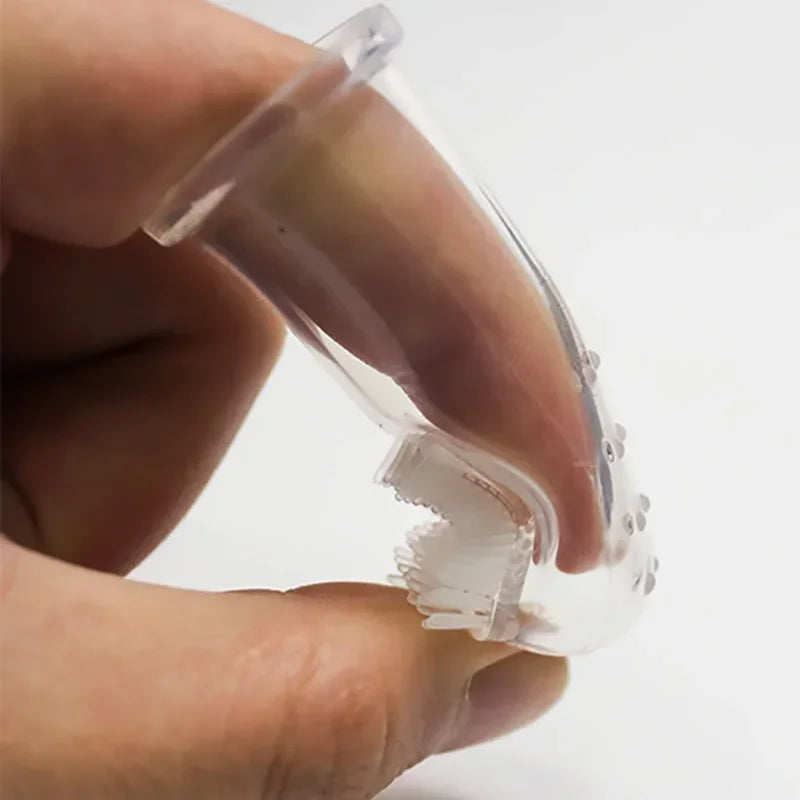
This is a toothbrush that fits on your finger. It's made from soft, flexible, food-grade silicone with gentle bristles on the tip and sides. You slide it over your index finger, apply pet toothpaste, and brush your dog's teeth using your finger as the brush.
The difference is control. With a handled toothbrush, you're operating at a distance. You can't feel the tooth surface, you can't gauge pressure, and you can't navigate around the mouth with any precision.
With a finger brush, your fingertip is the brush. You feel every tooth. You feel where the gumline starts. You feel the buildup on the back molars that you'd never reach with a rigid handle. You can adjust pressure instantly because you're getting direct tactile feedback through the silicone.
For your dog, the experience is completely different too. A finger in their mouth is familiar. Dogs are used to you handling their face, opening their lips, checking their teeth.
A rigid plastic stick being shoved past their gums is not familiar, and it triggers a fight-or-flight response in most dogs who haven't been desensitised to it from puppyhood. The finger brush bypasses that resistance because it feels like your hand, not a foreign object.
The silicone is soft enough that even if your dog bites down, it compresses without hurting either of you. No hard plastic jabbing into gums.
No rigid handle poking the roof of their mouth. Just a soft, textured surface moving across the teeth while your dog tolerates it because it's your finger and they've decided that's acceptable.
It works on cats too. If anything, finger brushes are better suited to cats than dogs because a cat's mouth is smaller and a handled brush is almost comically oversized for feline teeth.
The finger brush gives you the precision to work in a small space without traumatising your cat more than the grooming process already does.
What's Included
One silicone finger toothbrush. Fits most adult finger sizes. The silicone stretches slightly to accommodate, but it's designed for a standard index finger. If you have particularly large hands, it'll fit snugly. Particularly small hands, it may sit loosely. Test the fit before adding toothpaste.
"Does this actually make a difference?" Yes. Regular brushing, even two to three times a week, significantly reduces plaque and tartar buildup. The key word is regular. One session won't undo months of neglect, but consistent use slows the progression of dental disease and extends the time between professional cleanings. Your vet will notice.
"My dog won't let me anywhere near their mouth." Start slow. Let your dog sniff the brush. Put a dab of pet toothpaste on it and let them lick it off your finger. Then touch their front teeth for a few seconds and stop.
Do that for a few days. Gradually increase the time and move toward the back teeth. You're building tolerance, not forcing compliance. Most dogs accept it within a week if you don't rush it.
"How often should I use it?" Ideally, daily. Realistically, three times a week makes a meaningful difference. Something is always better than nothing. If you can do thirty seconds on each side every other day, you're ahead of most pet owners.
"Is silicone safe if my dog chews on it?" The brush is made from food-grade silicone, which is non-toxic. If your dog bites down during brushing, the silicone compresses safely. That said, this isn't a chew toy. Don't let your dog gnaw on it unsupervised. If they bite through it, replace it.
"Can I use human toothpaste?" No. Human toothpaste contains fluoride and xylitol, both of which are toxic to dogs. Use toothpaste specifically formulated for pets. This is non-negotiable.
"How do I clean the brush itself?" Rinse thoroughly with warm water after each use. You can sterilise it periodically by boiling it for two to three minutes. Silicone handles heat well. Replace the brush when the bristles start to flatten or wear down, which typically happens after a few months of regular use.
Backed by our 30-Day Satisfaction Guarantee.
The first session is always the messiest. Toothpaste everywhere, your dog mouthing your hand, neither of you entirely sure what's happening. The second session is a bit calmer. By the fifth, you've got a rhythm.
Your dog opens their mouth because they've learned that this takes thirty seconds and then they get a treat, and you can actually feel the difference on the tooth surface. Smoother. Cleaner. Less of that rough texture along the gumline that you didn't even realise was there.
It takes less than a minute. It costs almost nothing. And it's one of the few things you can do at home that your vet will genuinely thank you for.
FAQs
Q: Does this replace professional dental cleanings? A: No. It reduces the frequency and severity of professional cleanings, but it doesn't replace them. Think of it the way you think about your own teeth. You brush daily and still see a dentist. Same principle. Regular brushing at home means less buildup when your dog does need a professional clean, which means a shorter procedure and lower cost.
Q: What age should I start brushing my dog's teeth? A: As early as possible. Puppies who get used to finger brushing early accept it as normal for life. But it's never too late to start with an adult dog. The desensitisation process just takes a bit longer. Go slow, use positive reinforcement, and build up gradually.
Q: Will this fit a child's finger for helping with brushing? A: It could, but it'll likely be too loose on a small finger and could slip off inside the dog's mouth. Adults should handle the brushing. Kids can help by holding the dog still or dispensing treats after.
Q: Is one brush enough or should I buy multiples? A: If you have one dog, one brush is fine to start. Replace it when it wears down. If you have multiple pets, use a separate brush for each animal for hygiene reasons.