Skip to product information

Interactive Puzzle Feeder Toy | Treat-Hiding Slow Feeder, Non-Slip Base, Dogs & Cats

Interactive Puzzle Feeder Toy | Treat-Hiding Slow Feeder, Non-Slip Base, Dogs & Cats

Regular price $36.99
Regular price $36.99 Sale price
SAVE Sold out
 

check_circle Free Shipping

check_circle 30-Day Guarantee

check_circle Secure Checkout

  • American Express
  • Apple Pay
  • Google Pay
  • Mastercard
  • PayPal
  • Shop Pay
  • Union Pay
  • Visa
 
add_shopping_cart

-

Ordered

local_shipping

- - -

Order Ready

redeem

- - -

Delivered

Interactive Puzzle Feeder Toy | Treat-Hiding Slow Feeder, Non-Slip Base, Dogs & Cats

Interactive Puzzle Feeder Toy | Treat-Hiding Slow Feeder, Non-Slip Base, Dogs & Cats

Regular price $36.99
Regular price $36.99 Sale price
SAVE Sold out

Your dog finishes their meal in 45 seconds. You know this because you've timed it. Bowl down, face in, food gone, and now they're staring at you like you forgot the second course.

Then comes the boredom. The pacing. The whining. The shoe chewing. The couch cushion that apparently looked like a chew toy. The barking at absolutely nothing because they've got energy and zero outlet for it.

You've tried stuffing a Kong. It works for about five minutes. You've bought "interactive" toys that your dog figured out in two tries and never touched again. You've Googled "how to mentally stimulate my dog" and every article says the same thing: puzzle feeders. But the cheap ones are flimsy, too easy, or have pieces your dog just rips off and swallows.

The real problem isn't that your dog is destructive. It's that they're smart and understimulated. A dog with nothing to solve will find something to destroy. That's not a behaviour problem. That's a boredom problem.

How It Actually Works

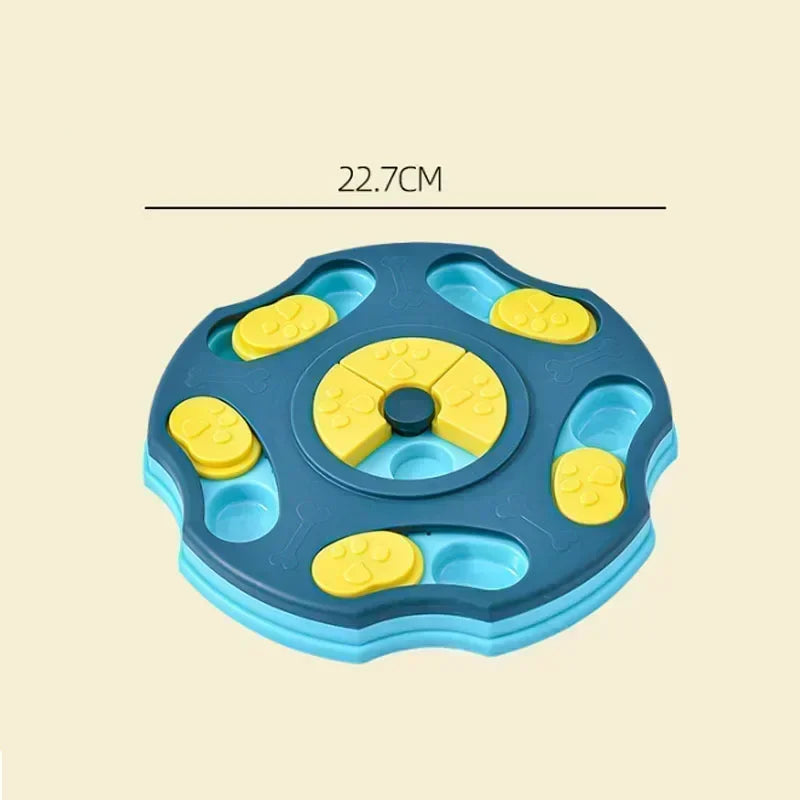
This is a flat, round puzzle board with multiple hidden compartments covered by sliding lids and rotating covers. You place treats or kibble into the compartments, close the covers, and let your dog figure out how to access the food.

Your dog has to use their nose to locate the treats, then use their paws and mouth to slide, flip, or spin the covers open. Each compartment works slightly differently, so your dog can't just learn one trick and repeat it across the whole board. They have to problem-solve their way through each section.

This does two things at once.

First, it slows down eating. Instead of gulping a full meal in under a minute (which causes bloating, gas, and in some breeds, dangerous stomach torsion), your dog works through their food one compartment at a time. Mealtime goes from 45 seconds to 10 or 15 minutes.

Second, it provides genuine mental exercise. Fifteen minutes of puzzle-solving tires a dog out more than thirty minutes of walking. A mentally tired dog doesn't chew your furniture. They sleep.

The base is non-slip, so the board stays put on hard floors while your dog works at it. No batteries, no apps, no electronics. Just a simple, mechanical puzzle that your dog can't cheat by flipping the whole thing over.

Material

Made from durable PP plastic. Lightweight, easy to clean, no high-concern chemicals. Food-safe for direct contact with treats and kibble.

Available Colours

Blue, pink, and additional colour options. Check the swatches on this page.

"My dog is too smart. They'll figure this out in two minutes." The first time, probably. But that's the point. You change the compartment layout each time. Hide treats in different sections. Use some compartments as decoys with nothing inside. The puzzle stays challenging because you control the setup, not because the toy itself changes. It's replayable every single meal.

"My dog is not that smart. Will they just give up?" Most dogs are more motivated by food than you'd expect. Start easy. Leave a few compartments open so they can see and smell the treat, then gradually close more of them as your dog learns the mechanics. Within a few sessions, even the laziest dog catches on because the reward is immediate. Solve the puzzle, get the food.

"Will my dog just flip it over and dump the treats out?" The non-slip base grips the floor and the weight distribution keeps it stable. Most dogs learn to work the sliding mechanisms because flipping the board doesn't actually release the treats from the closed compartments. If your dog is an absolute brute about it, hold the board steady during the first few sessions until they learn the intended approach.

"Is it easy to clean?" Yes. Rinse it under water or wipe it down after each use. The compartments are open and accessible once the lids are moved, so there's no hidden crevices where old food gets stuck and goes rancid.

Backed by our 30-Day Satisfaction Guarantee.

Here's what changes. Mealtime goes from a 45-second inhale to a 15-minute activity. Your dog is working, thinking, and problem-solving instead of vacuuming their bowl and looking for trouble.

After a puzzle session, your dog doesn't pace. They don't whine. They don't eyeball the couch cushions. They lie down. Because a dog that's been mentally worked is a dog that's actually tired, and a tired dog is a well-behaved dog.

You didn't need a trainer. You didn't need a bigger backyard. You needed to give their brain a job.

FAQs

Q: Can I use this as my dog's regular food bowl? A: Yes. Portion their regular kibble into the compartments instead of treats. It turns every meal into a slow-feeding puzzle session. Great for dogs who eat too fast.

Q: Is this suitable for puppies? A: Yes. Puppies benefit from mental stimulation even more than adult dogs. Start with easy setups (fewer closed compartments) and increase the difficulty as they learn. Supervise young puppies to make sure they're working the puzzle, not chewing the plastic.

Q: Does it work for cats? A: It does. Cats are natural problem-solvers and many cats will work the sliding compartments for treats. It's especially good for indoor cats who need more mental stimulation.

Q: How big is it? A: The board is a standard dinner-plate size. Large enough to hold a meaningful amount of treats or kibble, small enough to store in a drawer or cupboard when not in use.

Q: What if my dog loses interest after a few uses? A: Change the setup. Use different treat types (higher value treats in harder compartments). Leave some compartments empty as decoys. Mix it with kibble and high-value treats so some compartments are more rewarding than others. The puzzle stays interesting when the payoff is unpredictable.


View full details

Collapsible content

check_box

Specifications

check_box

FAQS

check_box

Shipping & Guarantee