Full Body Dog Waterproof Raincoat | Built-In Harness, Reflective Strips, Four-Leg Coverage, S to 3XL
Couldn't load pickup availability
check_circle Free Shipping
check_circle 30-Day Guarantee
check_circle Secure Checkout
-
Ordered
- - -
Order Ready
- - -
Delivered
Full Body Dog Waterproof Raincoat | Built-In Harness, Reflective Strips, Four-Leg Coverage, S to 3XL
It's raining. Your dog still needs to go outside. You put on their raincoat, the standard kind that drapes over their back and clips under the belly. You walk around the block. You come home. Their back is dry. Everything else is soaked. Their legs are drenched. Their belly is dripping. Their chest is wet through. They shake in the hallway and the walls get a fresh coat of muddy water. You spend ten minutes towelling them off while they squirm and you wonder what exactly the point of the raincoat was.
The problem with most dog raincoats is coverage. They protect the back because that's the easiest part to cover. But rain doesn't only fall from directly above. It bounces off the ground. It hits from the side in wind. Puddles splash up from underneath. Your dog's belly, which is the closest part of them to the ground, gets the worst of it. Their legs walk through every puddle, wet blade of grass, and muddy patch between your front door and wherever they decide to relieve themselves. A back-only raincoat in real rain is like holding a newspaper over your head in a storm. The gesture is there. The protection isn't.
Then there's the post-walk cleanup. A dog with four wet legs and a soaked belly tracks water through the house. Muddy paw prints on the floor. Wet dog smell on the couch. Fifteen minutes of towelling that your dog hates and you dread. On days when it rains twice, you do the whole routine twice. In winter, the wet stays cold against their skin for longer, and your small dog is shivering by the time you get them dry. The raincoat was supposed to prevent this. It didn't because it only covered a third of the dog.
How It Actually Works
This is a full-body raincoat. Four leg sleeves. Chest coverage. Belly coverage. Back coverage. Your dog goes out in the rain and comes back with their entire body dry underneath the suit. Not just the top. All of it.
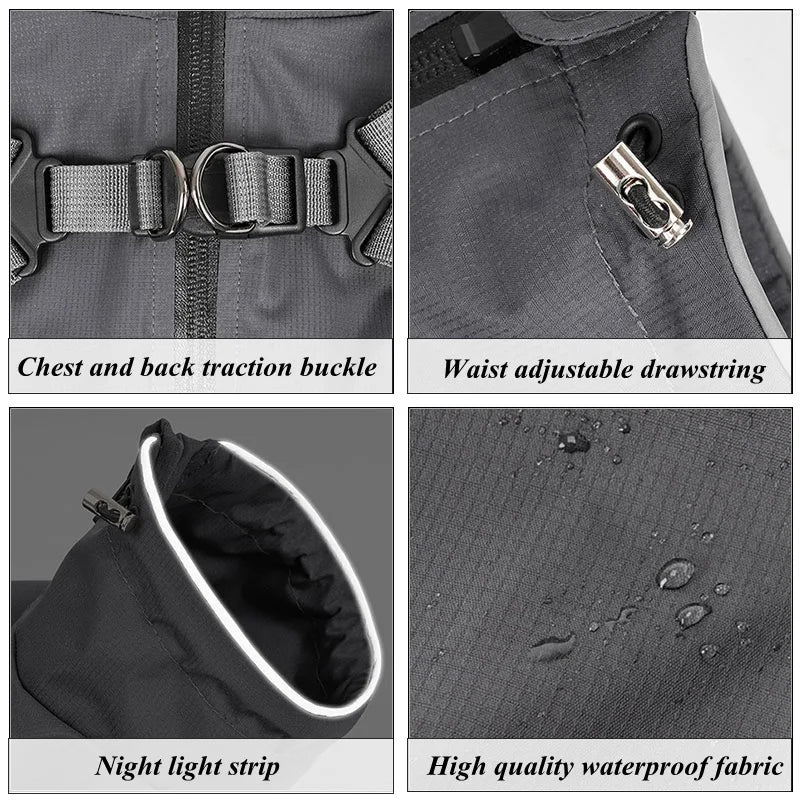
The outer shell is waterproof fabric that blocks rain, puddle splash, and wet grass from reaching your dog's coat. The legs are individually sleeved, which means each leg is enclosed and protected from the ground up. The belly panel connects the front and rear of the suit, covering the underside that every other raincoat ignores. When your dog walks through a puddle, the water hits the outside of the suit, not their fur.
The design is ergonomic, meaning it follows the shape of your dog's body rather than fighting it. The leg sleeves are cut to allow natural movement at the shoulders and hips. Your dog can walk, trot, squat, stretch, and run without the suit restricting their gait. This is the reason most people avoid full-body suits for their dogs. They've tried one before and their dog waddled in it, refused to walk, or stood motionless in the hallway like a statue of protest. That's a fit problem, not a concept problem. A properly fitted four-leg suit that's designed around how dogs actually move shouldn't restrict them any more than a pair of trousers restricts you.
The closure system uses buttons and a zip along the back, which makes getting it on and off significantly faster than wrestling your dog into a pullover suit. You lay it open, place your dog on it, thread the legs through, zip up the back, and button the top. The adjustable points at the neck, chest, and waist let you tighten or loosen the fit so it sits snugly without compressing. A snug fit prevents the suit from riding up, bunching at the legs, or ballooning with air when your dog moves.
There's a built-in traction buckle on the back for leash attachment. This means you don't need to layer a harness over the top of the raincoat. The leash clips directly to the suit. One less piece of equipment. One less layer of bulk. Your dog wears the raincoat and that's it. Walk-ready.
Reflective strips are integrated into the suit for visibility in low light. Rain and dark often come together. If you're walking at dawn, dusk, or on an overcast day, the reflective strips catch headlights and streetlights so drivers and cyclists can see your dog. It's a basic safety feature that most dog clothing doesn't include and should.
Colours
Red, Grey, Orange, Light Purple, Laser Grey. All waterproof. All functional. Red and orange are the most visible in rain and low light. Grey and purple are more subtle if you prefer your dog's outerwear to be understated.
Sizes
The size chart refers to the garment measurements, not your dog's measurements. Your dog's actual body measurements should be 3 to 5cm smaller than the listed garment sizes. This is built-in ease for comfortable fit. Measure your dog, then choose the size where the garment measurements are 3 to 5cm larger than your dog's actual numbers.
Measure your dog standing naturally. Back length from the base of the neck to the base of the tail. Chest girth at the widest part of the ribcage behind the front legs. Allow two fingers of space when measuring the chest so the fit isn't too tight.
S: Back length 21cm / 8.3in. Chest girth 41cm / 16.1in. Neck 27cm / 10.6in. For dogs 2.5 to 3.5kg (5.5 to 7.7lbs).
M: Back length 25cm / 9.8in. Chest girth 45cm / 17.7in. Neck 30cm / 11.8in. For dogs 3.5 to 4.5kg (7.7 to 9.9lbs).
L: Back length 29cm / 11.4in. Chest girth 49cm / 19.3in. Neck 32cm / 12.6in. For dogs 4.5 to 6.5kg (9.9 to 14.3lbs).
XL: Back length 33cm / 13in. Chest girth 53cm / 20.9in. Neck 35cm / 13.8in. For dogs 6.5 to 8.5kg (14.3 to 18.7lbs).
2XL: Back length 37cm / 14.6in. Chest girth 57cm / 22.4in. Neck 37cm / 14.6in. For dogs 8.5 to 9.5kg (18.7 to 20.9lbs).
3XL: Back length 41cm / 16.1in. Chest girth 61cm / 24in. Neck 40cm / 15.7in. For dogs 10 to 12.5kg (22 to 27.5lbs).
This raincoat is designed for small to medium breeds. Chihuahuas, Yorkies, Poodles, Shih Tzus, Cavaliers, French Bulldogs, Beagles, Miniature Schnauzers, Cocker Spaniels, and similar breeds. If your dog weighs more than 12.5kg, this suit likely won't fit.
Chest girth is the most critical measurement. A suit that's tight across the chest restricts breathing and movement and your dog will refuse to walk in it. If your dog's chest girth sits at the upper end of a size range, go up a size. Slightly loose is always better than slightly tight with dog clothing.
"Will my dog actually walk in a full-body suit?" This is the question everyone asks, and the answer is: almost certainly yes, with a brief adjustment period. Most dogs who freeze in full-body clothing are reacting to the unfamiliar sensation of fabric on their legs. Put the suit on indoors first. Let them wear it around the house for five minutes. Give them a treat. Take it off. Repeat the next day. By the third or fourth time, most dogs accept it. The moment they step outside in the rain and realise they're dry and comfortable, the deal is sealed. They'll tolerate the suit because the alternative is being cold and wet, and dogs are pragmatists.
"Is it actually waterproof or just water-resistant?" Waterproof. The outer fabric is designed to repel rain entirely, not just resist it. In sustained heavy rain, the seams are the most vulnerable points on any waterproof garment. For a typical 20 to 30 minute walk in rain, the suit keeps your dog dry. For an hour in a downpour, some moisture may eventually work through the seams at high-flex points like the leg joints. For normal wet-weather walks, it does the job.
"How do I deal with the legs? My dog hates having their paws handled." The leg sleeves are open at the bottom, so you're threading the leg through a tube, not forcing their paw through a narrow opening. Hold the sleeve open, guide the leg in, and slide it up. It's quicker and less confrontational than putting on dog boots. Most dogs who resist paw handling tolerate leg sleeves because you're working from above the paw, not gripping the foot itself.
"Can I wash it?" Hand wash in cold water and air dry. The waterproof coating can degrade in a washing machine over time, especially with hot water or harsh detergent. If it gets muddy, rinse it off with a hose or under the tap. For deeper cleaning, gentle hand wash with mild soap. Don't tumble dry. Don't iron. Hang it up and let it drip dry.
"Does the built-in harness attachment replace my regular harness?" For calm, well-behaved walkers on a normal lead, yes. The traction buckle on the back serves as a functional leash clip point. For dogs who pull hard, a dedicated harness underneath may still be necessary because the attachment point on a raincoat doesn't distribute pulling force across the chest the way a structured harness does. For a relaxed walk in the rain with a well-mannered small dog, the built-in attachment is all you need.
"My dog is a French Bulldog. Their body shape is unusual. Will this fit?" Frenchies are barrel-chested and short-backed, which makes any fitted clothing challenging. Measure the chest girth carefully and prioritise that measurement. You'll likely need to size up for the chest and accept that the back length runs slightly long. The adjustable points at the waist and chest help compensate for the Frenchie proportions. A slightly long suit is fine. A tight chest is not.
Backed by our 30-Day Satisfaction Guarantee.
It's raining. Properly raining. The kind of grey, persistent drizzle that doesn't stop for three days and turns every patch of grass into a swamp. You put the suit on your dog. Legs in, zip up, clip the lead. Out the door.
Your dog walks through the puddle at the end of the drive. Through the wet grass on the verge. Along the pavement where the rain is bouncing off the concrete. Past the muddy patch by the park entrance that usually results in a brown-legged dog and a twenty-minute towelling session.
You get home. You unzip the suit. Your dog steps out of it dry. Their legs are dry. Their belly is dry. Their chest is dry. You hang the suit on a hook by the door. You don't need a towel. You don't need to block access to the couch. Your dog walks straight to their bed and lies down, and the floor stays clean behind them.
Every other raincoat you've tried was a compromise. Covered the top, missed the bottom. This one covers the dog. That's the difference, and on the third rainy day in a row when you're not on your knees with a towel at 7am, it feels like the most obvious purchase you've ever made.
FAQs
Q: How long does it take to put on? A: Under a minute once you've done it a few times. Lay it open, place your dog's front legs in the front sleeves, rear legs in the rear sleeves, zip up the back, button the neck. The first time takes longer because you're both learning the process. By the fifth time it's routine.
Q: Does it have a hood? A: No. Most dogs dislike hoods because they restrict peripheral vision and muffle hearing, which makes them anxious. The suit covers the body and leaves the head free. If your dog's head gets wet in the rain, a quick wipe with a towel handles it. Keeping the head uncovered keeps your dog comfortable and aware of their surroundings.
Q: Can my dog go to the toilet in this? A: Yes. The suit is designed with the rear cut to allow your dog to relieve themselves without removing the suit. The tail area is open. Your dog can squat or lift their leg normally without the suit getting in the way.
Q: Is there ventilation? Will my dog overheat? A: Waterproof fabrics don't breathe the way cotton or mesh does. For a 20 to 30 minute walk in cool, rainy weather, overheating isn't an issue because the ambient temperature keeps your dog comfortable. Don't leave the suit on indoors or in warm conditions. Put it on before you walk out the door, take it off when you get home. It's outerwear, not loungewear.
Q: Will the waterproofing last or does it wear off? A: Waterproof coatings degrade over time with use, washing, and abrasion. With proper care (hand wash, air dry, avoid harsh detergent), the coating lasts through a full season or more of regular use. If you notice water starting to soak through rather than bead off the surface, the coating is wearing thin and it's time to replace.