Fine Grooming Comb | Shedding & Flea Removal, Dogs & Cats
Couldn't load pickup availability
check_circle Free Shipping
check_circle 30-Day Guarantee
check_circle Secure Checkout
-
Ordered
- - -
Order Ready
- - -
Delivered
Fine Grooming Comb | Shedding & Flea Removal, Dogs & Cats
You brush your dog regularly. You use a slicker brush or a deshedding tool and you pull out what looks like enough fur to build a second dog.
You think you're done. Then you run your hand through their coat and feel the matted layer underneath that the brush never touched. The topcoat looks fine. Underneath, it's a compressed mess of dead undercoat, dander, and trapped debris that your brush glided right over.
Most brushes are designed for the surface. They catch the loose fur that's already on its way out. They don't reach the fine, dense layer beneath the topcoat where matting actually starts, where fleas hide, where skin irritation builds up because dead hair is sitting against the skin with nowhere to go. Your dog looks groomed. They're not. Not properly.
Then there's the face. The ears. The area around the eyes and muzzle. You're not going to take a full-sized slicker brush to your dog's face. The pins are too aggressive, the head is too wide, and your dog will flinch every time you come near their eyes with something that looks like it belongs in a toolbox.
So those areas get skipped entirely, and that's where tear stains set, where food residue cakes in, and where mats form first on long-coated breeds.
How It Actually Works
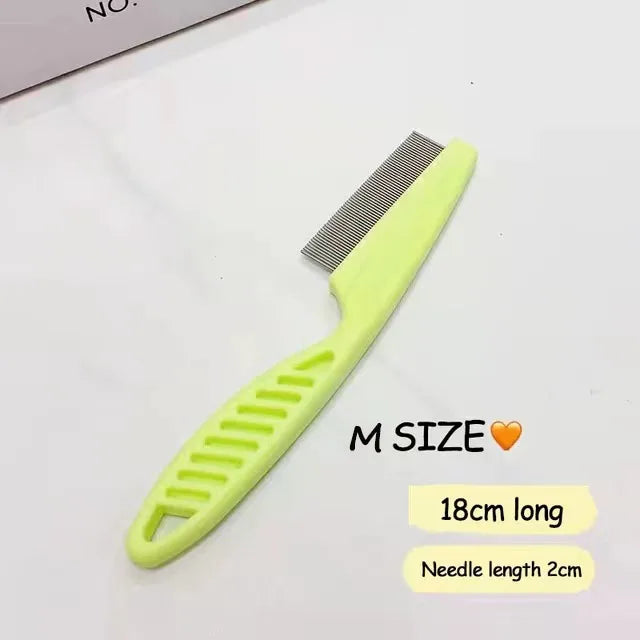
This is a fine-tooth comb with stainless steel teeth set close together. The teeth are thin enough to pass through dense coat without dragging, but close enough together to catch what wider-spaced tools miss: loose undercoat fibres, tiny tangles before they become mats, flea eggs, flea dirt, dander, and debris trapped against the skin.
The difference between a comb and a brush is precision. A brush covers area. A comb covers detail. You use the brush for the body, the broad strokes, the bulk removal.
You use this comb for the work that actually prevents problems: separating the fine hairs around the face, checking behind the ears where mats form silently, running through the chest and belly where undercoat compresses, and doing a flea check that catches what your eyes can't see.
The stainless steel teeth are smooth and rounded at the tips, so they glide through fur without scratching the skin. This isn't a rake. It's not pulling or tearing. The teeth separate the hair strand by strand, which is why it works on sensitive areas without your dog objecting. When the comb hits a tangle, you feel it immediately and can work through it gently before it becomes a mat that needs cutting out.
For flea detection, nothing beats a fine-tooth comb. Fleas are fast and small enough to avoid your fingers. Flea dirt, the tiny black specks that are actually flea excrement, is almost invisible against dark fur. A fine-tooth comb drags both out of the coat where you can see them. Run the comb through a section, tap it on a white paper towel, and if the specks turn reddish-brown when wet, that's flea dirt.
You've just confirmed an infestation before it got out of control. No other grooming tool gives you that diagnostic ability.
The handle is lightweight plastic, shaped for a comfortable grip during longer grooming sessions. The comb itself is compact enough to manoeuvre around small faces, behind ears, and along the jawline without bumping into anything.
Sizes
S: Narrower comb head. Designed for small breeds, puppies, cats, and detail work on faces and ears. If your pet is under 10kg or you're using this primarily for facial grooming, start here.
M: Wider comb head. Covers more area per stroke. Better for medium breeds or for full-body combing on small dogs. If you want one comb for general use, this is the versatile option.
S and M set: Both sizes together. Use S for the face and detail areas, M for the body. This is how professional groomers work, different tools for different zones.
Colours
Pink, White, Green, Blue, Yellow, and multi-colour options. Pick whatever you like. The colour doesn't affect the teeth.
"Is this just a flea comb?" It functions as a flea comb, but that's one use. It's a fine-tooth grooming comb that happens to be excellent at catching fleas because of the tooth spacing. Day to day, you'll use it more for deshedding, detangling, and face grooming than for flea removal. Think of the flea function as a bonus, not the whole purpose.
"Will it pull and hurt my dog?" If you drag it through a matted coat without working through tangles first, yes, it will pull. That's true of any comb. The correct technique is to start at the tips of the fur and work inward toward the skin in short, gentle strokes. If you hit resistance, stop and work through that section before continuing. Used properly, the rounded steel tips glide without scratching. Your dog shouldn't flinch.
"Does it work on long-haired breeds?" Yes, and arguably that's where it's most useful. Long-haired breeds are the ones most prone to hidden matting, undercoat compaction, and trapped debris. The fine teeth reach through length that wider tools skip over. For very thick or heavily matted coats, detangle with a wider comb or slicker brush first, then follow up with this for the fine work.
"Can I use it on a cat?" Absolutely. Cats are often easier to comb than brush because the comb is quieter, less visually intimidating, and the strokes feel more like being petted. The S size is ideal for cats. Many cat owners find this is the only grooming tool their cat tolerates.
"How do I clean it?" Pull the collected hair off the teeth after each session. For a deeper clean, rinse under warm water with a drop of dish soap, then let it air dry. Stainless steel won't rust under normal use. Don't leave it soaking in water for extended periods.
Backed by our 30-Day Satisfaction Guarantee.
You'll notice what this comb catches on the first pass. You'll run it through a section of coat you just brushed and it'll come out with a layer of fine undercoat and debris that the brush left behind. That's not because your brush is bad. It's because your brush has a different job. The brush gets the bulk. This comb gets everything else.
After a few sessions, the coat feels different under your hand. Lighter. Cleaner. The sections around the face and ears that used to get skipped are smooth and tangle-free. Your dog stops scratching at their ears because the trapped dead hair that was irritating the skin is gone.
It's a comb. It's the simplest grooming tool that exists. And it does the job that everything else in your grooming kit was missing.
FAQs
Q: How often should I comb my dog? A: For long-coated breeds, a quick comb-through two to three times a week prevents matting before it starts. For short-coated breeds, once a week is usually sufficient. For flea checks during flea season, comb after every outdoor session in high-risk areas.
Q: Is this a replacement for a regular brush? A: No. It's a complement. Your brush handles the bulk deshedding and surface grooming. This comb handles the precision work: faces, tangles, undercoat, and flea detection. Use both. They do different things.
Q: My dog has very short fur. Is this still useful? A: Yes. Short-coated breeds still shed, still get fleas, and still accumulate dead hair and dander against the skin. A fine-tooth comb on a short coat is quick, easy, and catches loose hair your hands miss.
Q: Will this remove ticks? A: No. Ticks attach to the skin and need to be removed with a tick removal tool or fine-point tweezers using a twisting motion. A comb may snag a tick that hasn't attached yet, but it's not designed for tick removal and you shouldn't rely on it for that.