Skip to product information

Enclosed Dog House Bed | Soft Coral Fleece, Removable Washable Cover, S to L

Enclosed Dog House Bed | Soft Coral Fleece, Removable Washable Cover, S to L

Regular price $39.99
Regular price $39.99 Sale price $99.99
SAVE 60% Sold out


check_circle Free Shipping

check_circle 30-Day Guarantee

check_circle Secure Checkout

  • American Express
  • Apple Pay
  • Google Pay
  • Mastercard
  • PayPal
  • Shop Pay
  • Union Pay
  • Visa
 
add_shopping_cart

-

Ordered

local_shipping

- - -

Order Ready

redeem

- - -

Delivered

Enclosed Dog House Bed | Soft Coral Fleece, Removable Washable Cover, S to L

Enclosed Dog House Bed | Soft Coral Fleece, Removable Washable Cover, S to L

Regular price $39.99
Regular price $39.99 Sale price $99.99
SAVE 60% Sold out

You bought your dog a bed. A flat, open, cushion-style bed. They slept on it once. Now they sleep behind the couch. Or under the desk. Or wedged between the wall and the side table in a spot so small you're not sure how they fit in there. You spent money on a bed and your pet chose a gap.

This isn't random. It's instinct. Small dogs and cats are den animals. They feel safest in enclosed, tight spaces with walls around them and something overhead. An open bed in the middle of the living room is the opposite of what their wiring is asking for. It's exposed on all sides.

There's no cover above them. Every noise, every movement, every draft hits them directly. They tolerate it during the day because you're there. At night, or when they're anxious, or when the house gets loud, they find a corner and press themselves into it because that's what feels like shelter.

Cats are even more specific about this. A cat will ignore a $60 bed and sleep in the cardboard box it arrived in because the box has walls. The box is enclosed. The box is a den. The cat doesn't care about the price tag. The cat cares about the geometry.

The problem with letting your pet sleep behind furniture is that you can't clean behind the couch every day, the floor is hard, there's no insulation from cold tiles, and dust accumulates in exactly the places your pet has decided to camp. They're choosing comfort in the wrong place because the right place isn't offering what they need.

How It Actually Works

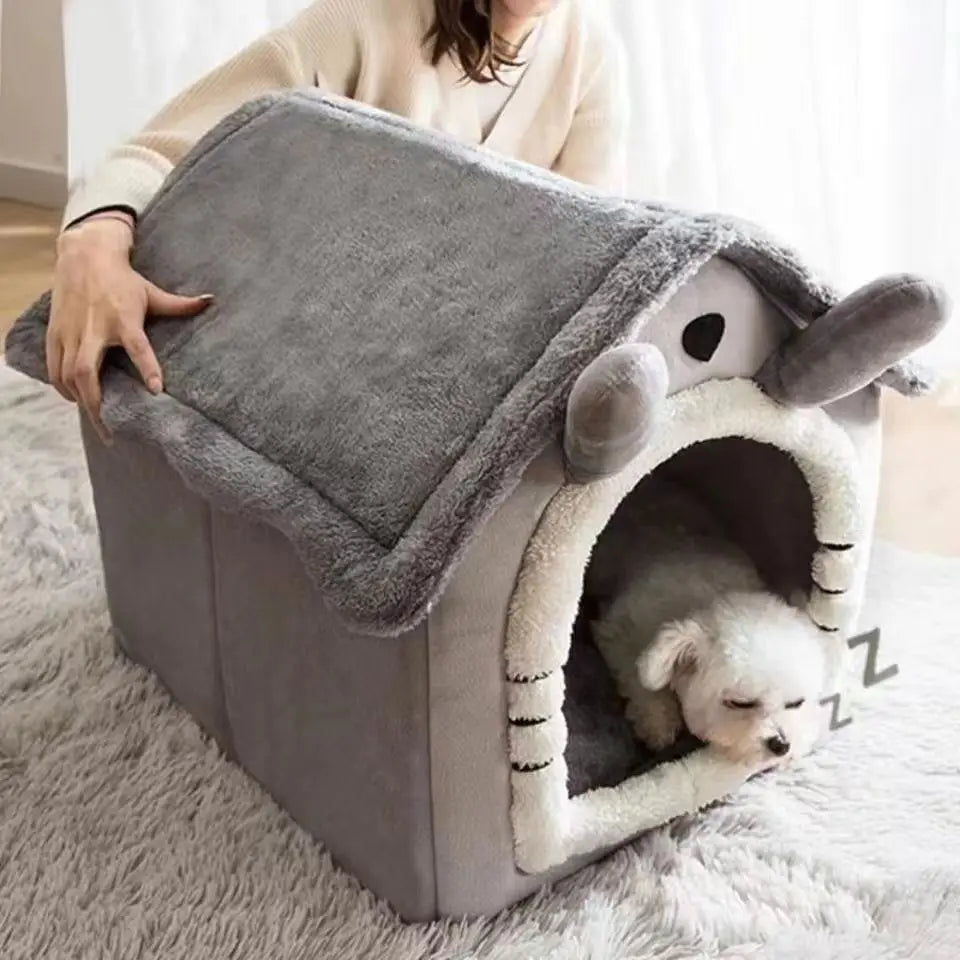
This is a pet bed built in the shape of an enclosed house. Four soft walls, a peaked roof, and a wide open entrance at the front. Your pet walks in, lies down, and is surrounded on all sides by soft coral fleece. The roof overhead blocks light and reduces ambient noise. The walls create a boundary that makes the interior feel protected. The opening is large enough for easy entry and exit but small enough that the inside still feels like a contained space.

The entire structure is made from coral fleece, which is a dense, soft, plush fabric that insulates well and feels warm against skin. The interior base is padded with a cushion that provides a comfortable sleeping surface. The floor padding is thick enough to insulate your pet from cold tiles or hardwood, which matters more than most people realise. Small dogs and cats lose body heat through their bellies when lying on cold floors. A raised, padded base stops that.

The design holds its shape without a rigid frame. The walls and roof are structured with enough internal padding to stay upright when empty, but the whole thing is soft and collapsible. If your pet likes to lean against the walls, they give. There's no hard skeleton inside that pokes through the fabric. It's plush all the way through.

The cover is removable and washable. Pet beds get dirty. Fur accumulates. Drool happens. Accidents happen. You need to be able to wash the thing regularly without destroying it. The outer fabric comes off, goes in the wash, dries, and goes back on. The inner cushion is also removable for separate cleaning. This isn't a bed you throw out in three months because it smells and you can't clean it. It's built to be maintained.

Styles

Grey: Neutral grey fleece with small ear details on the roof. Understated. Blends into most room décor without looking like a children's toy sitting in your living room.

Brown (Bear design): Tan and brown with bear face embroidery on the front and a small chimney detail on the roof. A bit more character. Popular with people who want the bed to look deliberately cute.

Both styles are functionally identical. Same material. Same construction. Same sizes. Pick the one that suits your space.

Sizes

S: 33 x 30 x 30cm. For pets up to 2kg. Kittens, very small cat breeds, teacup puppies. This is a compact den for the smallest pets.

M: 40 x 35 x 38cm. For pets up to 4kg. Most cats, Chihuahuas, Yorkies, toy breeds. The middle size that fits the widest range of small pets.

L: 45 x 40 x 45cm. For pets up to 7kg. Larger cats, small dogs like Cavalier King Charles, Miniature Dachshunds, and similar breeds. The most interior space and the tallest ceiling height.

Measure your pet from nose to tail base while they're curled up in their usual sleeping position. That's the space they actually use. Match that to the internal dimensions, not the external ones. If your pet stretches out fully when sleeping rather than curling, an enclosed bed may not be the right fit. This design suits pets who sleep curled or tucked.

"Will my pet actually use it?" If your pet already seeks out enclosed spaces, corners, under-furniture spots, or small gaps, yes. This bed gives them exactly what they're already looking for, just cleaner and more comfortable. Place it where they normally hide and they'll transition naturally. If your pet prefers sprawling in the open centre of the room, this isn't their style and a flat bed would suit them better. You know your pet.

"Is it warm enough for winter?" Coral fleece is a good insulator. The enclosed design traps body heat inside the structure, which means the interior warms up quickly once your pet is inside. For most indoor environments in winter, this is plenty warm. It's not insulated for outdoor use or unheated spaces. This is an indoor bed.

"Is it too warm for summer?" In warmer months, the enclosed design can trap heat. If your home isn't air-conditioned during summer, your pet may find it too warm and avoid the bed during hot weather. Some owners remove the roof panel or fold it back to create an open bed option in summer. It depends on your climate and your pet's tolerance.

"How do I wash it?" Remove the outer cover and cushion. Hand wash or gentle machine wash in cold water. Air dry. Don't tumble dry on high heat as it can damage the fleece and cause shrinkage. The coral fleece dries relatively quickly on its own. Wash regularly, especially if your pet uses the bed daily.

"Does it have a non-slip base?" The base is fabric, not rubberised. On hardwood or tile floors, it may slide if your pet enters enthusiastically. Placing it on a rug or mat underneath solves this. On carpet, it stays put on its own.

"Can I fold it flat for storage or travel?" Yes. The whole structure is soft with no rigid frame, so it collapses flat for packing or storage. Useful if you travel with your pet and want to bring a familiar sleeping space. It pops back into shape when you set it up again.

Backed by our 30-Day Satisfaction Guarantee.

You put the bed on the floor. Your cat looks at it from across the room. Ten minutes later they're circling it. Twenty minutes later they put their head inside the entrance. Thirty minutes later they're asleep in it, curled into a ball, completely hidden from view except for one ear poking out of the opening.

They don't sleep behind the couch that night. Or the next night. Or the night after that. The house bed becomes the spot. The non-negotiable, don't-touch-it, this-is-mine spot. You'll find them in there at 2pm on a Tuesday, at 11pm after dinner, and at 6am before you've woken up. The enclosed walls, the soft floor, the fleece that holds their warmth. It's everything they were trying to find behind your furniture, except it's clean, it's comfortable, and it's theirs.

Sometimes the best pet purchase isn't the most expensive one. It's the one that understands what your pet was already telling you they wanted.

FAQs

Q: My cat is 5kg. Should I get M or L? A: L. The M is rated for pets up to 4kg, and you want your cat to fit comfortably with room to adjust their position, not squeeze in. A bed that's slightly too large is always better than one that's slightly too small. Your cat will appreciate the extra space.

Q: Can two cats share one bed? A: If they're bonded and already sleep together, the L size can fit two small cats. But most cats prefer their own space. If you have two cats, two beds is the more reliable option. Cats sharing a den works until it doesn't, and then one cat claims it permanently and the other sleeps on top of the fridge out of spite.

Q: Will a puppy chew it apart? A: Possibly. Puppies chew everything, and soft fleece is easy to tear if they decide to work on it. If your puppy is in a heavy chewing phase, wait until they've matured past it before investing in a fabric bed. In the meantime, they'll happily sleep in a cardboard box lined with a towel and won't know the difference.

Q: Does it have any smell when new? A: Some fabric products arrive with a mild manufacturing scent. Air it out for 24 hours before giving it to your pet, or run it through one wash cycle first. The smell dissipates quickly.

Q: Can I put a heating pad inside it? A: You can place a pet-safe heating pad underneath the bottom cushion for extra warmth in winter. Don't use human heating pads, as they can overheat and aren't designed for use where pets can lie directly on them. Only use heating pads designed for pets, and follow their instructions for use inside enclosed spaces.

View full details

Collapsible content

check_box

Specifications

check_box

FAQS

check_box

Shipping & Guarantee