Dog Training Clicker | Coiled Wrist Strap, Raised Button
Couldn't load pickup availability
check_circle Free Shipping
check_circle 30-Day Guarantee
check_circle Secure Checkout
-
Ordered
- - -
Order Ready
- - -
Delivered
Dog Training Clicker | Coiled Wrist Strap, Raised Button
You're trying to train your dog using your voice. "Good boy." "Yes." "Good." Sometimes you say it enthusiastically. Sometimes you mumble it. Sometimes you say it half a second after the behaviour.
Sometimes two seconds after. Sometimes you say "good" when you actually mean "stop that." Your dog hears the same voice saying different things with different tones at different times and they have no idea which sound means "that exact thing you just did is what I wanted."
That's why voice-only training is slow. Your voice isn't consistent. Your tone changes with your mood. Your timing drifts. And your dog is trying to decode a language they don't speak based on a signal that keeps changing. They're not being stubborn. They're confused.
Professional trainers solved this decades ago. They use a clicker. One short, sharp, identical sound every single time. It cuts through ambient noise, it never changes tone, and it can be delivered in a fraction of a second. The dog hears the click and knows instantly: that thing I just did is correct, and a treat is coming. No ambiguity. No interpretation. Just a clean signal their brain can lock onto.
You've probably heard about clicker training. You've probably thought about trying it. You just haven't because it seems like one more thing to carry, learn, and figure out. It's not. It's a $10 piece of plastic that will do more for your training than any amount of repeating "good boy" ever will.
How It Actually Works
The science behind clicker training is called operant conditioning, but you don't need to know the science. You just need to know the process:
Your dog does something you want (sits, comes to you, lies down, stops barking, looks at you).
You press the clicker the instant they do it. The click sound marks the exact moment of the correct behaviour. You follow the click with a treat within one to two seconds.
Your dog's brain connects the click to the treat. After a few repetitions, the click itself becomes the reward signal. Your dog hears it and knows: whatever I was doing when that sound happened is what gets me food. They start repeating the behaviour on purpose because they want to hear the click.
The reason this works better than your voice is precision. You can click at the exact millisecond your dog's bum touches the floor for a sit. You can't say "good boy" that fast.
The click is instantaneous, identical every time, and emotionally neutral. It's a pure information signal. Your dog doesn't have to figure out your tone, your volume, or whether you actually meant it. Click means correct. That's it.
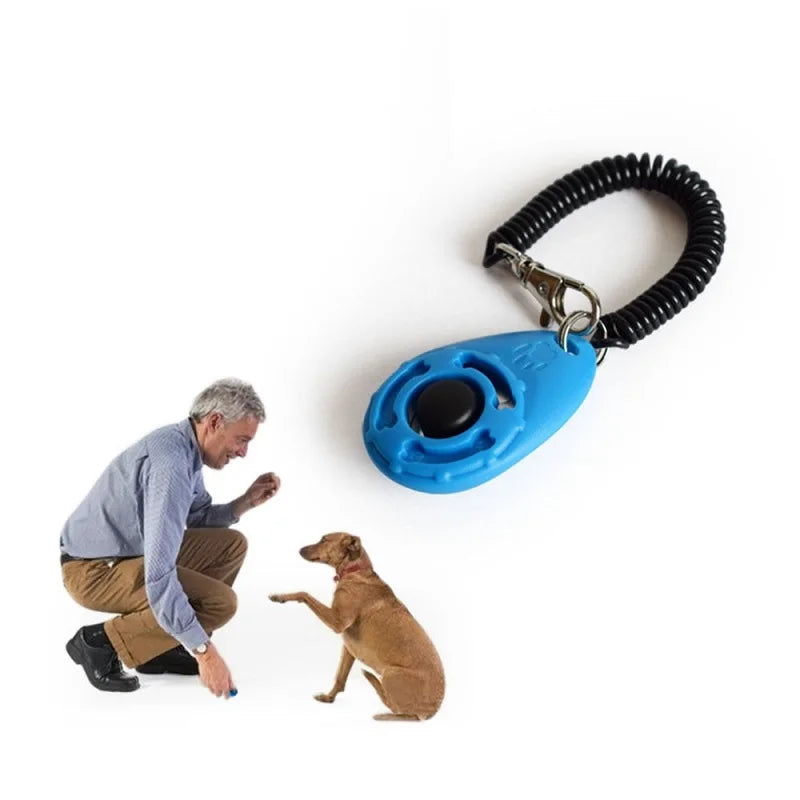
This clicker has a raised button that's easy to find with your thumb without looking at it.
You press it with one hand while the other hand holds the leash or delivers the treat. The click sound is loud and sharp enough to be heard clearly outdoors, at the park, and over background noise, but not so loud that it startles sensitive dogs.
The coiled wrist strap keeps the clicker attached to your wrist so it doesn't end up in your pocket, on the kitchen counter, or lost in the couch cushions when you need it.
The strap extends and retracts so the clicker sits in your palm when you're using it and hangs at your wrist when you're not. You always have it. That's important because consistency is the entire point.
Who Should Use This
Puppy owners starting basic obedience (sit, stay, come, down, leave it). Anyone teaching tricks (shake, spin, roll over, speak, touch). Owners working on leash manners and heel training. Anyone training a reactive dog to focus, disengage, or redirect.
Cat owners teaching recall, tricks, or target training. Anyone who's been saying "good boy" for six months and their dog still doesn't reliably sit on command.
If you use treats in training (and you should), adding a clicker between the behaviour and the treat makes the whole process dramatically faster.
Specs
Size: Approximately 60 x 40mm. Fits comfortably in any palm. Material: Plastic. Strap: Coiled elastic wrist strap with clip. Sound: Consistent, sharp click. Suitable for: Dogs, cats, and other trainable pets.
Available Colours
Cyan, black, blue, orange, red, pink, yellow, green, and more. Check the colour swatches. Pick whatever colour you won't lose in your house.
"Isn't clicker training complicated?" It's the opposite. Click when your dog does the right thing. Give a treat. That's the entire method.
There are no settings to adjust, no modes to learn, no apps to download. The clicker does one thing: make a sound when you press the button. The simplicity is what makes it effective.
"Can't I just use my voice instead?" You can, and your training will be slower and less precise. Your voice varies in tone, speed, and volume every time you speak. The clicker is identical every single time, which eliminates confusion for your dog. Trainers who switch from voice marking to clicker marking consistently report faster learning and more reliable behaviours. Your voice is great for praise and encouragement. The clicker is better for marking exact moments.
"Will the sound scare my dog?" Most dogs don't react negatively to the click. If your dog is sound-sensitive, start by clicking with the clicker behind your back or muffled in your hand to soften the sound. Pair every click with a treat. Within a few repetitions, your dog will associate the sound with food and start getting excited when they hear it rather than startled.
"My dog is old. Is it too late for clicker training?" No. Dogs learn at any age. Older dogs often respond to clicker training faster than puppies because they have longer attention spans and more impulse control.
If your senior dog can hear the click (test by clicking and watching for an ear flick or head turn), they can learn from it.
"Do I have to use the clicker forever?" No. The clicker is a teaching tool. Once your dog has reliably learned a behaviour, you can phase the clicker out and maintain the behaviour with verbal praise and occasional treats.
The clicker accelerates the learning phase. Once the behaviour is solid, you don't need it for that behaviour anymore (though you'll keep using it every time you teach something new).
Backed by our 30-Day Satisfaction Guarantee.
Day one. You click when your dog sits. They look confused. You give them a treat. They sit again experimentally. You click. Treat. Something changes behind their eyes.
Day three. Your dog sits the moment you stand still. They're offering the behaviour without being asked because they've figured out the pattern: sit equals click equals treat. They're not guessing anymore. They know.
Day seven. You've taught "down" and "touch" using the same method. Your dog is actively trying new things to see what gets a click. They're thinking. They're problem-solving. They're engaged in a way they've never been before because for the first time, the communication between you is crystal clear.
That's what a clicker does. It doesn't train your dog. It lets your dog understand what you're asking. Everything after that is just repetition.
FAQs
Q: How do I start clicker training if I've never done it? A: Start with "charging the clicker." Click and immediately give a treat. Repeat 10 to 15 times without asking for any behaviour. This teaches your dog that click equals food. Once they perk up at the sound of the click, you're ready to start marking behaviours. Click the instant your dog does something you want, then treat. That's the whole process.
Q: Can I use this for cat training? A: Yes. Cats respond well to clicker training, especially for recall (coming when called), tricks, and target training (touching a stick or your hand with their nose). Same process: click, treat. Cats learn quickly when food is involved.
Q: Does it matter which hand I hold the clicker in? A: Hold it in your non-dominant hand. Your dominant hand delivers treats. This way you can click and treat almost simultaneously without juggling. The wrist strap keeps it on you regardless of which hand you use.
Q: How loud is the click? A: Loud enough to be heard clearly in a park or outdoor setting. Not so loud that it startles most dogs at close range. If your dog is very noise-sensitive, muffle the clicker in your hand for the first few sessions until they associate it with treats.
Q: What treats work best with clicker training? A: Small, soft, high-value treats your dog loves. The treat should be eaten in one second so your dog is immediately ready for the next repetition. Tiny pieces of chicken, cheese, or commercial training treats work well. Avoid large treats that take time to chew because they break the rhythm of click-treat-repeat.
Q: Is this just for basic commands or can I use it for behaviour problems? A: Both. Clicker training works for teaching new behaviours (sit, stay, come) and for modifying problem behaviours (reactivity, excessive barking, jumping up, leash pulling). For behaviour problems, you're clicking and rewarding the alternative behaviour you want instead of the problem behaviour. A trainer or online resource on clicker-based behaviour modification can walk you through specific protocols.